


Key Insights
Bitcoin prices war before traditional markets can open. For 48 hours after the Iran strikes, Bitcoin was the only liquid signal of global risk sentiment, making it the leading indicator institutions now watch when equities are closed.
Recovery is now driven by institutional ETF flows, not retail. This means dips during geopolitical shocks are increasingly buying opportunities rather than capitulation events, because ETF capital rebalances on quarters, not headlines.
Bitcoin shifts from risk asset to macro hedge mid-conflict. Allocators can no longer model Bitcoin with a static correlation assumption, because its behavior during a crisis is fundamentally different from its behavior going into one.
On February 28, 2026, the United States and Israel launched coordinated strikes on Iran. It was a Saturday. Every equity exchange on Earth was closed. Gold could not trade. Treasuries could not trade. The only major liquid asset available for global price discovery was Bitcoin.
Within minutes, over $128 billion in crypto market value evaporated. Bitcoin fell from roughly $66,000 to $63,000. More than $500 million in derivatives positions were liquidated over the weekend. By Monday morning, before U.S. equity markets had even opened, Bitcoin had already reclaimed most of its losses. By March 11, it was up 7% from pre-strike levels. Gold was flat. The S&P 500 was down about 1%.
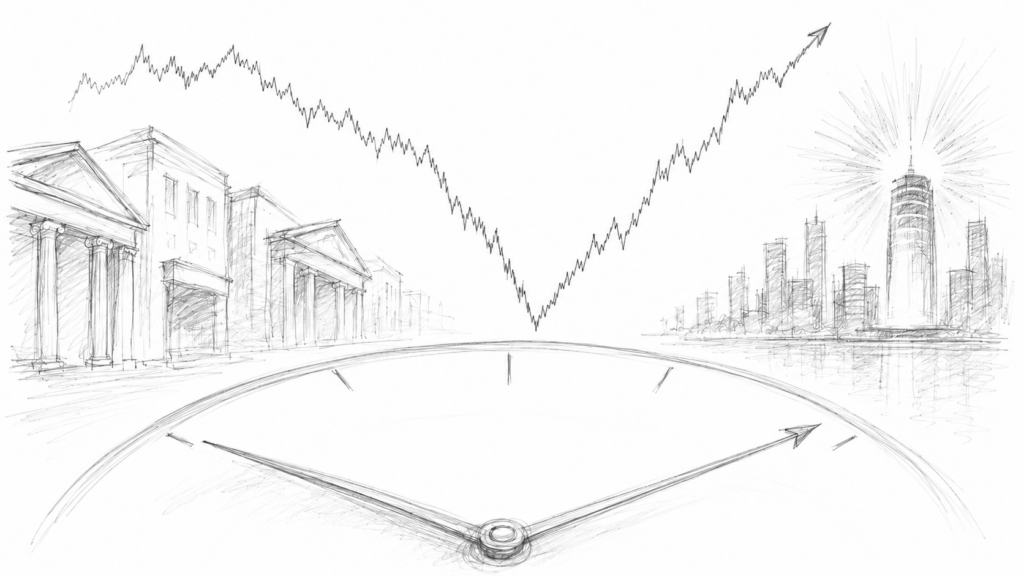
I have been watching this pattern repeat across four geopolitical conflicts now, and the data tells a story that I think is underappreciated. Risk assets dip on war headlines. They rally after. This is well-established in equities, where 80+ years of data confirms it. What is less well understood is that Bitcoin follows the same playbook but on a compressed timeline and with a larger recovery magnitude. The structural reasons for this divergence are becoming harder to dismiss with each successive conflict.
The Equity Baseline Is Extremely Well-Documented
Before getting to Bitcoin, the equity side needs to be established, because the pattern there is the foundation everything else sits on.
I pulled data from four major institutional studies that cover the longest time horizons available. LPL Research analyzed 20+ military conflicts since World War II. Carson Investment Research compiled S&P 500 returns across 48 geopolitical shock events from 1940 to 2026. J.P. Morgan Private Bank studied 36 events over roughly the same period. Goldman Sachs looked at seven comparable episodes since 1950. The numbers converge on the same conclusion.
The average S&P 500 drawdown following a geopolitical shock is roughly 5%. Markets bottom in about 19 days. Full recovery takes about 42 days. At the six-month mark, the S&P 500 is positive in roughly 60% of cases. At the twelve-month mark, that number rises to around 70%, with a median return in the high single digits. The average one-day reaction on the event date itself is only about -1.1%.
These are averages, and the dispersion matters. When I looked at the event-level data, the pattern gets more specific. The conflicts that produced large, sustained drawdowns share one feature: direct disruption to energy supply chains. The 1973 Yom Kippur War and Arab oil embargo took the S&P 500 down 16%. Iraq’s invasion of Kuwait in 1990 caused a 17.5% drawdown that took 189 days to recover. Russia’s invasion of Ukraine in 2022 produced a 7.4% decline over months, with the energy shock hitting European manufacturing competitiveness.
Compare that to conflicts without an energy dimension. The Cuban Missile Crisis (1962) produced a drawdown of under 7% and recovered in about two weeks. After 9/11, the S&P 500 dropped 11.9% and recovered in 30 days. The 2003 Iraq invasion actually saw the Dow rise 2.3% on day one and 8.4% over the first month, because months of anticipation had already priced in the uncertainty, and the event itself resolved it. The Israel-Hamas war in October 2023 produced no initial dip in U.S. equities at all, and the S&P 500 returned nearly 35% over the following year.
The lesson from equities is straightforward. Markets do not fear war. They fear uncertainty. Once a conflict becomes legible, even if the situation is bad, markets can price it and move forward. Selling at the moment of peak panic has been the wrong decision in the vast majority of historical cases. The two exceptions involved sustained oil supply disruptions that fed into inflation and forced central bank tightening. The variable that turns a temporary drawdown into a prolonged bear market is energy, not the conflict itself.
S&P 500 Performance After Major Geopolitical Shocks (Selected Events)
| Event | Date | Max Drawdown | Days to Bottom | Days to Recovery | 1-Year Return |
|---|---|---|---|---|---|
| Pearl Harbor | Dec 1941 | -20.3% | ~120 | ~30 from low | +7.6% |
| Korean War | Jun 1950 | -11.99% | ~18 | ~60 | +28.8% |
| Cuban Missile Crisis | Oct 1962 | -6.68% | 13 | ~14 | +21.6% |
| 9/11 Attacks | Sep 2001 | -11.89% | 11 | 30 | -13.75% |
| Iraq Invasion | Mar 2003 | Rallied | N/A | N/A | +26.4% |
| Iraq Invades Kuwait | Aug 1990 | -17.47% | 71 | 189 | +13.66% |
| Russia-Ukraine | Feb 2022 | -7.4% | N/A | N/A | -5.13% |
| Israel-Hamas | Oct 2023 | No initial dip | N/A | N/A | +34.88% |
| Iran War | Feb 2026 | -9% | ~15 | ~55 | TBD |
Sources: First Trust/S&P CapIQ/Bloomberg (Q1 2026), LPL Research/Factset/Strategas, Carson Investment Research
Bitcoin Follows the Same Pattern, Faster
Bitcoin has now been through four significant geopolitical shocks. The sample is small compared to 80+ years of equity data. But the pattern is consistent enough across all four events that it deserves serious attention.
When Russia invaded Ukraine on February 24, 2022, Bitcoin dropped about 8% in hours, falling to roughly $34,300. Four days later, it posted its largest single-day gain in over a year, climbing 14.5%. By late March, it was trading approximately 27% above pre-invasion levels, near $47,000. The S&P 500, over the same 30-day window, was down about 2.5%. Bitcoin’s recovery was faster by an order of magnitude.
The 2022 case has a major confound. The Federal Reserve launched its most aggressive hiking cycle in four decades simultaneously, and Bitcoin eventually fell 65% over the year. You cannot cleanly attribute that annual decline to the war. But the initial 30-day dip-and-recovery pattern is worth isolating, because it reappeared in every subsequent conflict.
When Hamas attacked Israel on October 7, 2023, Bitcoin dropped 1.7% on day one to $27,500, and continued sliding to about $26,541 by October 11. The drawdown was notably shallow compared to 2022. Within 50 days, Bitcoin was well above where it started, eventually rallying to $35,000 as the ETF approval narrative took over. An event study by Pandey et al., published through ScienceDirect (2024), found that Bitcoin and Ethereum did not show statistically significant abnormal returns in response to the Israel-Hamas conflict, while several G20 equity markets did. Bitcoin was becoming less reactive to geopolitical shocks, not more.
The India-Pakistan conflict in May 2025 was the briefest test. Bitcoin dipped to $94,671 on the day India launched Operation Sindoor, then recovered to $102,758 within three days. This was a regional conflict between two nations outside the global energy supply chain, with no Strait of Hormuz risk and no direct oil disruption. The market priced it accordingly: small dip, fast recovery. Multiple analysts noted at the time that Bitcoin was responding more to U.S. monetary policy signals than to the conflict itself.
Then came Iran. The February 28, 2026 strikes produced the cleanest natural experiment yet. Bitcoin sold off 8.5% because it was the only market open. It recovered within days because institutional buyers stepped in through ETFs on Monday. By two weeks out, it had outperformed the S&P 500, gold, and Asian equities. By two months, it had gained roughly 19% from its lows while the S&P 500 was still working through a 9% drawdown. CoinDesk documented an additional dynamic within the Iran conflict: each successive negative headline produced a smaller Bitcoin selloff, and each recovery held at a higher level. The war-linked drawdown was literally shrinking in real time.
Across all four events, the same sequence plays out. Bitcoin drops alongside equities in the initial risk-off panic. It bottoms faster. It recovers faster. And the magnitude of recovery relative to equities is consistently larger.
Bitcoin vs. S&P 500: Head-to-Head Across Four Geopolitical Shocks
| Event | BTC Initial Drop | BTC Days to Bottom | BTC 30-Day Return | S&P 500 30-Day Return | BTC Outperformance |
|---|---|---|---|---|---|
| Russia-Ukraine (Feb 2022) | -8% | <1 day | +27% above pre-event | -2.5% | ~+30pp |
| Israel-Hamas (Oct 2023) | -1.7% | 5 days | +25% (50 days) | +3% (no dip) | ~+22pp |
| India-Pakistan (May 2025) | -2.4% | <1 day | +6% (3 days) | -1.1% (Sensex) | ~+7pp |
| Iran War (Feb 2026) | -8.5% | <1 day | +7% (2 weeks), +19% (2 months) | -1% (2 wks), -6% (through Mar) | +8 to +25pp |
Sources: TradingView, CoinDesk, Fortune, BeInCrypto, The Market Periodical, IndexBox
Three Structural Reasons for the Divergence
The interesting question is not whether Bitcoin recovers faster. The data across four events is fairly clear on that. The interesting question is why. I see three structural explanations that hold up under scrutiny.
Bitcoin is the only major liquid market that never closes.
This sounds obvious, but the implications during a geopolitical shock are significant and underappreciated. When the Iran strikes landed on a Saturday, Bitcoin absorbed the entire global panic by itself. Over $11.5 billion traded on Hyperliquid alone across Saturday and Sunday, and Bloomberg cited Hyperliquid’s crude oil perpetual contract as the most relevant price indicator during the weekend, because there was no other liquid market available. By the time Asian markets opened on Monday, the initial shock had been partially digested. By the time U.S. markets opened, Bitcoin had already reclaimed most of its weekend losses.
The consequence is that Bitcoin compresses both the panic and the recovery into a shorter window. It prices the shock first, which means it also begins recovering first. Equity investors waking up on Monday were reacting to a shock that Bitcoin had already spent 48 hours processing. Gabe Selby at CF Benchmarks described this as crypto’s 24/7 structure becoming “increasingly an edge for the asset class.” Matt Hougan at Bitwise went further, saying that for much of that Sunday, “onchain finance was the center of the financial world.”
The institutional ETF bid has fundamentally changed Bitcoin’s recovery mechanism.
The market structure underneath Bitcoin is completely different in 2026 than it was in 2022. When Russia invaded Ukraine, Bitcoin’s holder base was predominantly retail and heavily leveraged. There were no U.S. spot Bitcoin ETFs. Recovery was driven by short-squeezes and opportunistic retail buying.
In 2026, institutional ownership of Bitcoin ETFs has climbed to 38% of total assets, with hedge funds, pension funds, and registered investment advisors holding more than $40 billion in shares collectively. Cumulative inflows into U.S. spot Bitcoin ETFs have reached approximately $56.5 billion since inception. On the first trading day after the Iran strikes (Monday, March 2), institutions poured $458 million into Bitcoin ETFs. Over the following two weeks, $1.7 billion flowed in. CoinDesk reported that these inflows appeared to be outright bullish bets rather than market-neutral basis trades, because the yields on basis trade setups were too low to justify the positioning.
This matters because institutional ETF capital behaves differently than retail capital. It rebalances quarterly, not daily. It does not respond to a 10% dip by panic-selling. The capital entering through a pension allocation or RIA commitment has a holding period measured in years. This creates a structural floor under the price that did not exist before 2024. When retail sold into the Iran panic over the weekend, the institutional bid was waiting on Monday morning.
Post-halving supply dynamics amplify the effect. Miners now produce approximately 450 BTC per day, down from 900 before the April 2024 halving. ETF demand alone has been absorbing 4,500 to 5,000 BTC daily at peak periods. That is a 10:1 demand-to-supply ratio flowing through regulated channels before counting any other source of demand. When a geopolitical shock flushes out leveraged positions and short-term holders, the supply available for sale decreases even further, and the institutional bid absorbs the slack at a discount.
Bitcoin undergoes a real-time correlation regime change during conflicts.
During the initial hours of every geopolitical shock, Bitcoin sells off alongside equities. It behaves like a correlated risk asset. Then something shifts.
Bryan Tan at Wintermute documented this precisely during the Iran war. In the initial conflict phase, Bitcoin fell while gold rallied, the textbook risk-off response. But within days, both assets began rising together as the U.S. dollar weakened. The BTC-gold correlation shifted from -0.49 to +0.16. Tan described this as a statistically significant regime change that had not appeared during prior geopolitical crises. At the same time, the Coinbase Bitcoin premium (measuring U.S. spot demand relative to global exchanges) turned positive on March 2 for the first time in 40 days, a direct signal that institutional spot buyers had returned. Over the following five sessions, IBIT (BlackRock’s Bitcoin ETF) gained 3.75% while IGV (the iShares Tech-Software ETF) fell 2.45%. JPMorgan noted that Bitcoin’s options-implied volatility was compressing while GLD’s was rising, which they interpreted as a sign of institutional maturity.
The reclassification happens in real time. Bitcoin enters the conflict as a risk asset and exits it behaving like something closer to a macro hedge. This transition appears to be happening faster with each successive conflict.
Structural Comparison: Bitcoin Market in 2022 vs. 2026
| Metric | Feb 2022 (Russia-Ukraine) | Feb 2026 (Iran War) |
|---|---|---|
| U.S. spot Bitcoin ETFs | Did not exist | $135B AUM |
| Institutional ownership of BTC ETFs | N/A | 38% of total assets |
| ETF inflows on first trading day after shock | N/A | $458 million |
| ETF inflows in first 2 weeks | N/A | $1.7 billion |
| Daily mined BTC supply | ~900 BTC/day | ~450 BTC/day |
| ETF demand-to-mining supply ratio | N/A | ~10:1 |
| BTC recovery mechanism | Retail short-squeeze | Institutional ETF buying |
Sources: Amberdata, Bloomberg Intelligence, CoinDesk, Kavout, Intellectia, Investing.com
The Academic Literature Supports the Overreaction Thesis
The behavioral finance literature provides a framework that maps onto what the market data shows. The central question is whether the initial geopolitical selloff represents rational repricing or emotional overreaction that subsequently corrects. The research points strongly toward overreaction.
Zaremba et al., published in the Journal of Financial Stability (2021), studied how surges in country-specific geopolitical news affect stock returns. Their finding is that geopolitical shocks trigger investor overreaction, with emotional responses creating selling pressure beyond what fundamentals justify. Prices get pushed below fundamental value. The mispricing then corrects through a return reversal in the subsequent period. This framework maps directly onto the equity data across 48 events: an average drawdown of roughly 5%, followed by full recovery within 42 days. The selloff overshoots, then mean-reverts. Applied to Bitcoin, the implication is that if overreaction creates the mispricing, and Bitcoin’s 24/7 structure compresses both the overreaction and the correction into a shorter window, then the magnitude of the rebound per unit of time should be larger. That is exactly what shows up across four conflicts.
The most useful paper for the Bitcoin-specific thesis comes from Chibane and Janson, published in Finance Research Letters (2025). They built a crash model using S&P 500 and Geopolitical Risk Index data, where the probability of an equity crash is driven by geopolitical risk. They then tested which assets provided protection during those crash scenarios. Bitcoin and the Swiss Franc function as safe havens against geopolitically-driven equity crashes. Gold and Treasury bonds do not. The critical nuance is that this protective quality shows up specifically during large market dislocations, not during moderate variations. This maps onto the observed two-phase pattern with precision. When Bitcoin sells off 8.5% alongside everything else in the first hours, that is the moderate variation phase where it behaves like a correlated risk asset. When the recovery kicks in and Bitcoin outperforms gold, equities, and Asian markets over the following weeks, that is the large dislocation phase where the safe-haven properties activate.
The ECB’s research blog (September 2022) analyzed the geopolitical risk premium in equities after Russia’s Ukraine invasion. They found a clear distance-to-Kyiv effect in the first 14 days: equity markets in countries closer to Ukraine corrected more sharply. But by day 40, the premium had faded entirely. Geopolitical risk premiums are temporary and self-correcting. The IMF’s April 2025 Global Financial Stability Report reinforced this, finding that a text-based war discourse index has significant predictive power for expected U.S. equity returns. War talk moves prices in a predictable direction, and the reversal pattern creates identifiable return dynamics in the data.
On diversification, Bhuiyan et al. (2023) found that Bitcoin provides better diversification than gold during crisis periods. Kumar, Mohan, and Niveditha (2025), using a rolling-window DCC-GARCH model published in SAGE Journals, reached a complementary conclusion: Bitcoin can serve as an effective hedge against volatility in equities and commodities. Hoffmann et al. (2025), studying 17 invasions from 2001 to 2022, found that wars produce stronger negative equity responses in emerging markets than in advanced economies, which helps explain why regional conflicts can hammer local stock markets while Bitcoin, as a globally traded asset, absorbs the same shock with less magnitude and faster recovery.
Key Academic References
| Study | Published | Core Finding |
|---|---|---|
| Zaremba et al. (J. Financial Stability) | 2021 | Geopolitical shocks cause overreaction; prices undershoot, then reverse |
| Chibane & Janson (Finance Research Letters) | 2025 | BTC is a safe haven against geopolitical equity crashes; gold and Treasuries are not |
| ECB Blog (Schmitz & Sigmund) | Sep 2022 | Geopolitical risk premium visible at 14 days, fully faded by 40 days |
| IMF GFSR Chapter 2 | Apr 2025 | War discourse index predicts expected U.S. equity returns |
| Bhuiyan et al. | 2023 | BTC provides better crisis diversification than gold |
| Kumar, Mohan & Niveditha (SAGE) | 2025 | BTC is an effective hedge against equity and commodity volatility |
The Progression Across Four Conflicts
When I lay the four events side by side, what emerges is not just a repeating pattern but an evolution in how Bitcoin processes geopolitical shocks.
The initial drop has not gotten smaller. The 2026 Iran selloff (-8.5%) was nearly as sharp as the 2022 Russia-Ukraine drop (-8%). Bitcoin still behaves like a risk asset in the first hours of a geopolitical shock, and there is no evidence that this initial sensitivity is decreasing.
What has changed is the recovery mechanism. In 2022, recovery was driven by short-squeezes, sanctions-evasion demand from Russian and Ukrainian citizens, and opportunistic retail buying. The institutional infrastructure did not exist to provide a structural bid. In 2026, $458 million in ETF inflows landed on the first available trading day, followed by $1.7 billion over two weeks. The recovery is now being driven by institutional capital flowing through regulated vehicles, and that capital has a fundamentally different time horizon and risk tolerance than the retail traders who drove recoveries in earlier cycles.
The confounding macro variable has also shifted. In 2022, the Fed was hiking aggressively, which overwhelmed the initial war-driven recovery and sent Bitcoin down 65% over the year. The war signal and the macro signal were entangled. In 2023, no major macro headwind existed, and Bitcoin’s war-driven recovery flowed smoothly into the ETF approval rally. In 2026, the macro overlay is more complex: oil above $100 creates potential stagflation risk, but the institutional ETF bid has been strong enough to sustain positive price action despite that headwind. The data suggests that Bitcoin’s recovery mechanism has become robust enough to partially offset macro drag that would have overwhelmed it in prior cycles.
The India-Pakistan event is the outlier in terms of magnitude, and for the right reason. It was a regional conflict with no energy supply disruption, no Strait of Hormuz risk, and no direct impact on global commodity prices. The market sized it correctly with a minimal dip and immediate recovery. This is actually the strongest evidence that the pattern is rational rather than mechanical: Bitcoin’s geopolitical response scales with the severity and global relevance of the conflict, which is exactly what you would expect from an efficiently-priced, globally-traded asset.
Evolution of Bitcoin’s Geopolitical Response
| Dimension | Russia-Ukraine (2022) | Israel-Hamas (2023) | India-Pakistan (2025) | Iran War (2026) |
|---|---|---|---|---|
| Initial BTC drop | -8% | -1.7% | -2.4% | -8.5% |
| Days to recovery | 4 | 5 | <1 | <3 |
| 30-day BTC return vs pre-event | +27% | +25% (50d) | +6% (3d) | +7% (2wk), +19% (2mo) |
| BTC vs S&P 500 outperformance | ~+30pp | ~+22pp | ~+7pp | +8 to +25pp |
| Recovery mechanism | Short-squeeze, retail | ETF narrative | Monetary policy sensitivity | Institutional ETF buying |
| Energy supply disruption | Yes (European gas) | Moderate (oil fears) | None | Yes (Strait of Hormuz) |
| Macro confound | Fed hiking cycle | None | None | Oil inflation risk |
What This Means, and What It Does Not
The data across four conflicts and 80+ years of equity history points toward a specific, narrow conclusion. Geopolitical shocks create temporary mispricings through emotional overreaction. The correction follows within weeks for equities, and within days for Bitcoin. Bitcoin’s 24/7 market structure, institutional ETF infrastructure, and post-halving supply dynamics compress both the panic and the recovery into a tighter window, producing a faster and larger rebound relative to equities.
This pattern has been consistent across conflicts of varying type, severity, and geographic scope. The structural explanations are plausible and supported by academic research. The institutional infrastructure that now underpins Bitcoin’s recovery mechanism (38% institutional ETF ownership, $56.5 billion in cumulative inflows, a 10:1 ETF demand-to-mining supply ratio) did not exist before 2024 and is still growing.
There are real limitations to this thesis. Four events across four years with different macro backdrops is a small sample. The 2022 case is confounded by the Fed hiking cycle. The 2025 India-Pakistan event was too brief and regional to stress-test the thesis properly. And the most important caveat from the equity data applies to Bitcoin with equal force: the conflicts that produced prolonged bear markets in equities were the ones that involved sustained energy supply disruptions feeding into inflation and central bank tightening. The 2026 Iran war carries precisely this risk. If oil remains elevated and forces the Fed to delay rate cuts, the institutional ETF bid may not be strong enough to offset that headwind indefinitely.
But four events showing the same pattern, with structural explanations that have grown stronger rather than weaker over time, constitutes a thesis worth taking seriously. The market data, the institutional flow data, and the academic literature all point in the same direction. Whether the next geopolitical shock confirms or breaks the pattern will tell us something important about what Bitcoin has become.
This article is for informational and analytical purposes only. Nothing in this piece constitutes financial, investment, or trading advice. Cryptocurrency and equity investments carry significant risk. Past performance does not indicate future results.

