

On February 28, the US and Israel launched coordinated strikes on Iran under “Operation Epic Fury,” killing Supreme Leader Ayatollah Ali Khamenei, the IRGC commander-in-chief, and over 40 senior officials. Iran retaliated within hours with missiles and drones targeting Israel, the UAE, Qatar, Kuwait, Bahrain, Jordan, and Saudi Arabia. Three US service members have been killed. Trump has outlined a four-to-five-week timetable and signaled continued operations. As of March 3, the conflict remains active with no ceasefire.
Markets already know this is a shock. The real question is whether it becomes a sustained regime shift in energy prices, inflation expectations, and central bank policy.
Everything downstream, from equities to crypto, hinges on one variable: the Strait of Hormuz.
Gulf Shipping Insurance Repriced Before Markets Opened
The oil price moved, but the insurance market moved first.
War risk underwriters issued cancellation notices for Gulf shipping policies on Saturday, before financial markets even opened. In most geopolitical events, insurance repricing lags the market reaction.
This time it led.
| Metric | Pre-Strike | Current / Post-Strike |
|---|---|---|
| War risk premium (% of vessel hull value) | ~0.25% | 0.5%+ (Marsh est. 25-50% increase) |
| Single-transit premium ($150M vessel) | ~$375,000 | ~$750,000+ |
| VLCC daily rate, ME-to-China (TD3C) | ~$55,000/day (Jan 2026) | ~$170,000/day (W225), highest since April 2020 |
| TD3C rate, YTD change | – | Nearly tripled since Jan 1 |
| Tankers anchored in Gulf waters | – | 150+ |
| Container war risk surcharge (Hapag-Lloyd) | – | $1,500/TEU standard, $3,500/TEU reefer |
| Container emergency surcharge (CMA CGM) | – | $2,000/20ft dry, $3,500/40ft |
| Airspace closures | – | Iran, Iraq, Kuwait, Israel, Bahrain, Qatar; Dubai airport shuttered |
The practical (napkin) chokepoint math: roughly 20 million barrels per day transit Hormuz (~20% of global consumption), along with ~33% of global seaborne crude and ~20% of global LNG. VLCC spot rates on the benchmark Middle East-to-China route have nearly tripled since January 1 to approximately $170,000/day, the highest since the 2020 oil price war. This was already happening before the strikes due to fleet consolidation (South Korea’s Sinokor now controls ~78 VLCCs, roughly 24% of the spot-trading fleet).
The conflict has accelerated a freight market that was already structurally tight.
The cancellations are the mechanism that matters here: they create a de facto blockade even without a physical closure. If vessels cannot obtain coverage at any price, particularly those with US or Israeli business connections (where brokers report quotes reaching 0.7% of hull value), traffic stops regardless of whether Iran formally closes the strait.
Bitcoin Absorbed the Weekend Sell-Off on Low Leverage
Bitcoin is the only large liquid asset trading 24/7.
When the strikes hit Saturday morning, crypto absorbed the full force of global risk-off selling that would normally distribute across equities, bonds, and commodities.
| Metric | Data |
|---|---|
| BTC pre-strike | ~$67,000 |
| BTC intraday low (Feb 28) | $63,038 |
| BTC Monday close | ~$69,120 (+5% on day) |
| BTC current (Mar 3 AM) | ~$68,200 |
| BTC distance from ATH ($126,080, Oct 2025) | -46% |
| Crypto market cap wiped (first hour) | ~$70B |
| Crypto market cap wiped (24hr) | ~$128B |
| Total liquidations (24hr) | $515-522M |
| Long liquidations | ~$445-473M |
| Traders liquidated | ~152,000 |
| Sell volume surge (single hour) | ~$1.8B |
| BTC open interest at crash | ~$43.4B |
| ETH intraday low | ~$1,835 (-4.5% to -9% across weekend) |
But the initial drop was contained relative to the magnitude of the event. The market entered this shock already heavily deleveraged.
BTC had already fallen 47% from its October ATH. A $19B liquidation cascade in late October, months of institutional outflows ($6.38B in BTC ETF redemptions from November through February), and a February 5 crash that VanEck classified as a -6.05 sigma event had already flushed the system. ETF balances have dropped from 1.36 million BTC at the October peak to ~1.26 million BTC today, a reduction of approximately 87,000 BTC in forced selling. Net assets in spot BTC ETFs have contracted from $170B to roughly $84B.
The prior bear market made the crash shallower, but the same conditions that cushioned the downside (low leverage, weak sentiment, institutional withdrawal) also cap the upside. There is no structural bid for a sustained rally until either the conflict resolves or liquidity conditions materially improve.
Monday’s Recovery in Equities, but Rising Yields Underneath
US equities staged an intraday recovery, climbing from a 1.2% loss to flat.
The bond market, though, told a different story: the 10-year Treasury yield rose 7bps despite the geopolitical shock, because markets are pricing oil-driven inflation ahead of safe-haven demand. In our opinion, that is the critical tell.
| Asset | Friday Close | Monday Close | Move | Structural Context |
|---|---|---|---|---|
| S&P 500 | 6,878.88 | 6,881.62 | +0.04% | Recovered from -1.2% low; Nvidia +2.9%, MSFT +1.5% led dip-buying |
| Brent Crude | $72.87/bbl | $77.74/bbl | +6.7% | Eight-month high; Wells Fargo worst-case $100+/bbl > S&P 6,000 |
| Gold | ~$5,248/oz | ~$5,400/oz | +2% | +22% YTD, +100% last 12mo; seven consecutive monthly gains (longest in decade). Market cap ~$37.6T |
| US 10Y Yield | 3.97% | 4.04% | +7bps | Rising yields = inflation priced above safety. Real rate ~1.7-1.8% |
| US Dollar Index | ~97.3 | ~98.2 | +0.95% | Five-week high; erased 2026 losses |
| VIX | ~17 | ~20 | +18% | Above long-run trend, but far from panic |
| Bitcoin | ~$65,800 | ~$69,120 | +5% | -23% YTD, -46% from ATH. Market cap ~$1.3T (gold is 28x larger) |
| BTC ETFs | – | +$458M Mon | Best Q1 day | $6.38B outflows Nov-Feb; AUM collapsed $170B to $84.3B |
| Gold ETFs | – | – | – | +$16B inflows YTD vs. BTC ETFs’ -$4.5B |
| KOSPI (Tue) | – | – | -7.23% | Largest fall in 19 months; wiped ~$270B |
| S&P Futures (Tue) | – | – | -0.9% | Monday relief rally already being tested |
Wells Fargo mapped the downside scenario: if oil sustains above $100/bbl on a prolonged Hormuz closure, their worst-case S&P target is 6,000, roughly 13% below Friday’s close. Morgan Stanley countered with history: the S&P has averaged +2%, +6%, and +8% at one, six, and twelve months following geopolitical risk events going back to the Korean War.
The question is whether this event stays within the historical distribution or breaks it.
Capital Rotated Into Tokenized Gold On-Chain
Ultimately, the data point that we feel deserves the most attention from the weekend isn’t in equities or BTC. It’s in tokenized gold.
The sector’s market cap has now surpassed $6 billion, with daily trading volumes for both PAXG and XAUT exceeding $1 billion on Monday, a sharp multiple of typical activity. On Binance alone, PAXG traded $310M in volume; XAUT recorded $932M across exchanges. Three on-chain flows illustrate the scale of rotation: Abraxas Capital Management received 28,723 XAUT tokens ($151M) directly from Tether’s treasury, the largest recorded XAUT transfer in three weeks.
An Ethereum whale swapped 1,000 ETH (~$1.94M) for XAUT at $5,413 per token, accepting a realized loss of over $60,000 to exit. A dormant wallet activated after five months, spending $1M USDC on PAXG and XAUT while holding another $4M USDC in reserve.
The safe-haven verdict is in the flows. Gold added $1.65 trillion in market cap in a single session on January 29, nearly matching BTC’s entire market capitalization. Gold ETFs have absorbed $16 billion in inflows YTD while BTC ETFs have bled $4.5 billion.
As CoinDesk analyst Randin noted, the 20-day BTC-Nasdaq correlation swung from -0.68 to +0.72 between early and mid-February. That is not decorrelation. That is instability. When missiles fly, the safe-haven question resolves itself pretty fast.
But the important nuance for crypto is that investors are not exiting the ecosystem to buy physical gold. They are rotating within it, from ETH and BTC into tokenized bullion on-chain.
This behavior did not exist in prior geopolitical shocks, and it suggests crypto infrastructure is developing its own internal safe-haven plumbing.
Sovereign Funds Bought What Retail Was Forced to Sell
While ~152,000 retail traders were liquidated over the weekend, institutions were doing the opposite. Abu Dhabi sovereign funds Mubadala and Al Warda added BTC ETF exposure in mid-February, sizing positions before the strikes hit. Strategy (formerly MicroStrategy) purchased 3,015 BTC at ~$67,700 during the same week. US spot BTC ETFs recorded $1.1B in net inflows across three sessions (Feb 25-27), snapping a five-week outflow streak, and followed with $458M on Monday, one of Q1’s strongest inflow days.
The pattern mirrors the June 2025 12-Day War (the Israel-Iran conflict of June 13-24, when Israeli and US strikes on Iranian nuclear and military infrastructure triggered a crypto selloff from $3.4T to $3T in market cap before a full recovery post-ceasefire). In both cases, patient institutional capital bought the geopolitical dip.
Whether this cohort is early or wrong depends entirely on how the Hormuz situation evolves.
How Oil and the Fed Determine Whether This Range Holds
The medium-term path for crypto runs through a single transmission chain: oil prices, then inflation expectations, then Fed policy flexibility, then global liquidity, then risk asset pricing.
Arthur Hayes made the contrarian structural argument: since 1985, every US president who initiated Middle East military operations prompted the Fed toward easier policy (Gulf War 1990, post-9/11 2001, Afghanistan surge 2009). The framework is worth holding in mind, but it deserves scrutiny.
The sample size is three episodes across 35 years, and the causal mechanisms were fundamentally different in each case: the Gulf War coincided with a savings-and-loan crisis already forcing easing; post-9/11 easing came during a dotcom recession already underway; the 2009 Afghanistan surge overlapped with GFC-era zero rates.
Attributing a clean “war > Fed eases” pattern to what were largely coincident macro crises overstates the signal.
That said, if the pattern were to hold, it would imply conflict ultimately accelerating rate cuts and balance sheet expansion on a multi-month lag.
The counterforce is already visible. The 10-year yield rose Monday despite the shock. Treasury yields now sit at 4.04%, and the real rate remains positive at roughly 1.7-1.8%, making risk-free instruments competitive with Bitcoin’s zero-yield proposition. The Fed ended quantitative tightening in December 2025, but monetary policy remains restrictive.
Benjamin Cowen of ITC Crypto describes Q1 2026 as a “late-cycle restrictive digestion” phase, noting that durable ETF inflows have historically only followed falling real yields or a clear easing cycle. Neither condition has developed yet.
These scenarios are illustrative, not predictive. The directional logic matters more than the specific numbers.
| Scenario | Oil | Fed Response | BTC Directional Implication |
|---|---|---|---|
| Short conflict, Hormuz reopens quickly | $70-75 stabilization | No change, holds | Neutral to mildly positive; relief bounce, then back to range trading |
| 4-5 week operation, limited disruption | $80-90 sustained | Holds, but rhetoric tilts dovish | Positive on multi-month lag if easing expectations build; upside skewed but timing uncertain |
| Prolonged conflict, sustained closure | $100+ | Stagflationary bind; holds or tightens | Negative; $60K support retested, risk of deeper correction if yields keep rising |
The prolonged scenario is worth walking through because the transmission mechanism is specific. Oil above $100 forces the Fed into a stagflationary bind: cut rates to support growth and risk embedding energy-driven inflation, or hold and watch credit conditions tighten further.
In that environment, real yields stay elevated or rise, which compresses the valuation of all zero-yield assets, Bitcoin chief among them. The $60K level isn’t arbitrary. It is the zone where three prior February tests found buyers and where the cost basis of late-2025 ETF inflows clusters.
A sustained break below it would trigger forced selling from that cohort, the same reflexive mechanism that drove the October liquidation cascade, only with less institutional dry powder available to absorb it.
Bottom Line
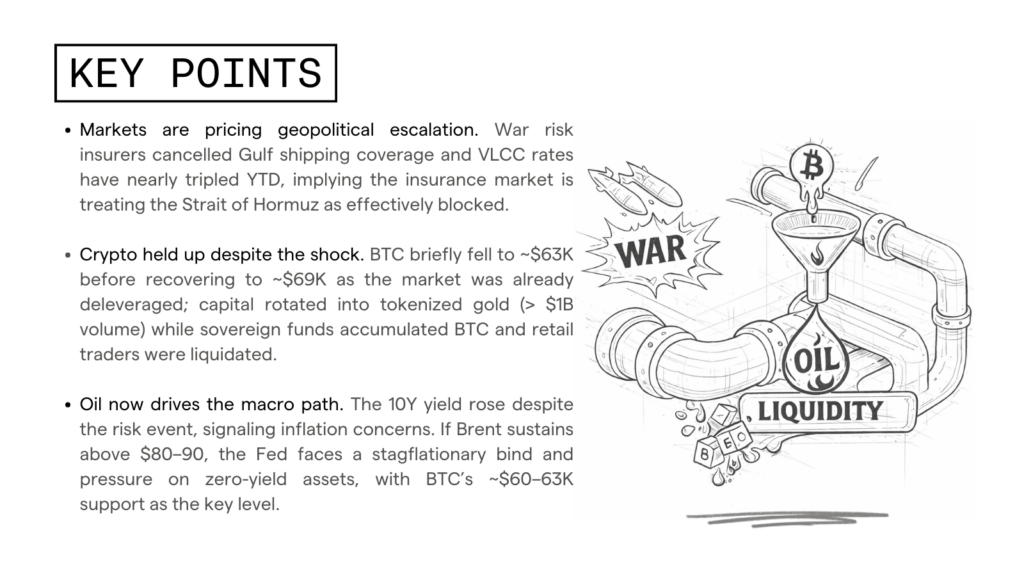
The Monday equity recovery suggests markets are, for now, treating this as a contained geopolitical event. But the Hormuz situation is not contained: insurers cancelled coverage before markets opened, VLCC rates have tripled YTD to six-year highs, and container lines are layering $1,500-3,500 surcharges per box.
If tanker traffic remains frozen and oil pushes above $80-90 sustained, the inflationary feedback loop into Fed policy will dominate all other narratives.
For BTC, the cleanest read: the prior deleveraging provides a floor (the $60-63K zone has been tested three times in February and held), but five consecutive monthly declines, $6.38B in ETF outflows since November, and a correlation structure that can’t decide whether BTC is risk-on or risk-off leave no foundation for a sustained breakout.
The catalyst is either conflict resolution or genuine dovish signaling from the Fed. The Hayes “war loosens the Fed” thesis is a useful framework, but the historical precedents it draws on were largely coincident with independent macro crises that were already forcing easing. This time, the Fed faces a stagflationary bind if oil sustains above $80, a fundamentally different constraint.
Until one of those catalysts arrives, the range holds with asymmetric downside risk on any Hormuz escalation.

