

Key Insights
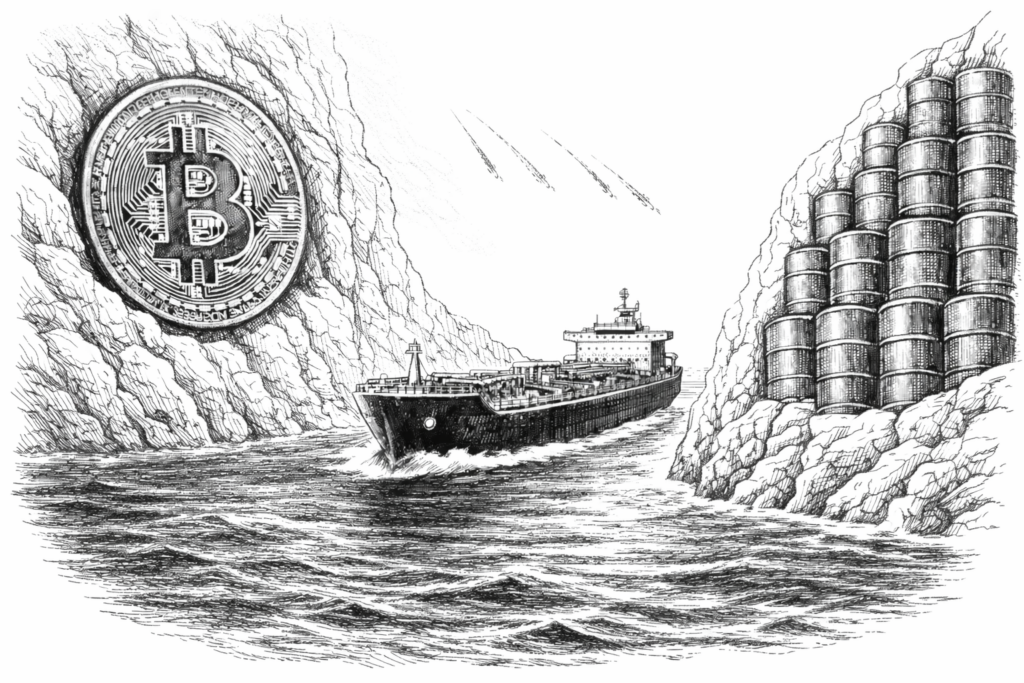
Bitcoin is range-bound between an institutional floor and a geopolitical ceiling. Every rally since February has been triggered by ceasefire rumors and sold on escalation headlines. The pattern has repeated at least three times.
The short squeeze was mechanical, not fundamental. Fear and Greed sat at 9 for over a month. Short liquidations hit $197M against $77M in longs, a 3:1 ratio. The Axios ceasefire headline was the catalyst, but the fuel had been building for weeks.
The Strait of Hormuz is the only variable that matters. A ceasefire without tanker traffic normalization delivers a headline rally that fades. A ceasefire that restores shipping collapses the oil premium and re-levers the entire risk curve. That distinction is the difference between $65K and $80K.
Bitcoin has spent six weeks trapped in a $65,000 to $73,000 range. The floor is institutional, the ceiling is geopolitical.
Since February 28, when the United States and Israel launched Operation Epic Fury against Iran and the Strait of Hormuz was effectively closed to commercial shipping, every major Bitcoin rally has been triggered by ceasefire rumours and every selloff by escalation headlines.
The pattern has repeated at least three times. On each occasion, the rally faded within days as the physical reality of closed shipping lanes reasserted itself.
On the Sunday that just passed, that pattern appeared again. President Trump posted an expletive-laden ultimatum on Truth Social threatening to destroy Iran’s power plants and bridges by Tuesday evening if the Strait remained closed.
Within hours, Axios reported that the U.S., Iran, and regional mediators were discussing terms for a 45-day ceasefire, the most structured diplomatic framework reported since the conflict began. Bitcoin jumped 3% to $69,120, its highest level in more than a week. The move was driven almost entirely by the mechanical unwinding of heavily skewed short positioning.
The analytical question is whether this time is different; the ceasefire proposal carries more structural detail than previous signals. The positioning asymmetry that produced today’s squeeze was unusually extreme. Further, the Morgan Stanley spot Bitcoin ETF, launching April 8 at a market-leading 0.14% expense ratio, introduces a new institutional flow catalyst. Each of these variables deserves examination.
The Mechanics of a Short Squeeze
Of $273.8 million in total crypto futures liquidations over the past 24 hours, short positions accounted for $196.7 million versus $77.1 million in longs. That is a 3:1 ratio. The largest single liquidation was a $10.17 million ETH-USDT short on Binance.
The Axios ceasefire headline was the catalyst, but the fuel had been accumulating for weeks.
The Fear and Greed Index sat at 9 entering the weekend, pinned in extreme fear territory where it has been for over a month. Social media sentiment across X, Reddit, and Telegram hit its most bearish skew since the war began. In 2022, comparable single-digit readings on the Fear and Greed Index accompanied the LUNA crash and the FTX implosion, both of which involved 20% to 30% single-day drawdowns.
This time, Bitcoin has been grinding sideways while sentiment collapsed around it, creating a gap between price stability and positioning that made the market mechanically vulnerable to any positive catalyst.
The Morgan Stanley ETF adds a second dimension. Its 0.14% expense ratio undercuts BlackRock’s IBIT at 0.25% and Grayscale’s BTC fund at 0.15%, making it the cheapest spot Bitcoin product on the market. Morgan Stanley’s distribution network spans 16,000 financial advisors managing $6.2 trillion in client assets.
Record March ETF inflows had already been providing a persistent bid under the market. The addition of a Wall Street bank’s distribution channel to that bid is a structural change in the buyer base.
Forty-Five Days and Two Bargaining Chips
The Axios report, sourced to four U.S., Israeli, and regional officials, describes a two-phased diplomatic framework. Phase one would be a 45-day ceasefire during which negotiators would pursue a permanent end to the war.
Phase two would be a formal agreement on ending hostilities. Pakistani, Egyptian, and Turkish mediators are facilitating, with text messages exchanged directly between U.S. Middle East envoy Steve Witkoff and Iranian Foreign Minister Abbas Araghchi.
The same report states that the chances of reaching even a partial deal within 48 hours are slim. The structural obstacle is straightforward: Iran’s two main bargaining chips are the Strait of Hormuz and its highly enriched uranium stockpile.
Tehran will not relinquish either for a 45-day pause. Mediators are exploring partial confidence-building measures on both issues, but Iranian officials have communicated clearly that they refuse to accept a framework resembling the Gaza or Lebanon ceasefires, where hostilities resumed at the discretion of the opposing side.
Trump has now extended his Hormuz deadline three separate times. The original 48-hour ultimatum was issued on March 21. It was extended to a 10-day window on March 26, with an expiry of April 6. On Sunday he pushed the deadline to Tuesday at 8:00 PM Eastern Time.
Each extension has followed the same sequence: escalatory rhetoric, followed by signals of possible negotiation, followed by a postponement. The market has learned to fade both the threats and the promises. Polymarket’s April 7 ceasefire contract sits at 4%, down from 12% a week ago. The April 30 contract is at 27%, down from 40%. May 31 is at 42%, down from 52%.
Tanker traffic confirms the scepticism. Only 21 tankers have transited the Strait of Hormuz since the war began, compared with more than 100 ships daily before the conflict. Ship insurance premiums for Hormuz transits remain at crisis levels.
Until these physical indicators change, rallies driven by political statements will continue to be sold.
The Institutional Floor Beneath the Fear
The most unusual feature of this drawdown is the divergence between retail sentiment and institutional behaviour.
The Fear and Greed Index has been in single digits for a month. Thirty-day apparent demand is negative 63,000 BTC, meaning the broader market is selling faster than institutions can absorb. Whales holding 1,000 to 10,000 BTC have swung from adding 200,000 BTC a year ago to removing 188,000 today, one of the most aggressive distribution cycles on record.
And yet the price has held.
Bitcoin is trading just 21% above its realized price of approximately $54,000, a level that signals proximity to a cycle bottom closer than any point in three years. But the $65,000 floor has absorbed every wave of selling since early March. The institutional bid, driven by ETF inflows and the imminent Morgan Stanley launch, is providing structural support that has prevented the kind of capitulation event typically associated with sentiment readings this extreme.
The critical question for the next 30 days is whether this floor holds. ETF flows turned negative in the final week of March at negative $296 million after three consecutive weeks of inflows totalling over $1.4 billion.
If the Morgan Stanley launch re-accelerates institutional flows, the floor strengthens. If flows remain negative and whale distribution continues, the $65,000 support level becomes progressively more vulnerable to a geopolitical shock.
Positioning Snapshot
| Indicator | Current Reading | Implication |
|---|---|---|
| Fear and Greed Index | 9 (extreme fear) | Lowest sustained reading since FTX collapse; historically precedes reversals |
| 30-Day Apparent Demand | Negative 63,000 BTC | Broader market selling faster than institutions absorb |
| Whale Distribution (1K–10K BTC) | Removing 188,000 BTC (was +200,000 a year ago) | Most aggressive distribution cycle on record |
| ETF Flows (Week of Mar 27) | Negative $296 million | First weekly outflow after three weeks of net inflows |
| Realized Price Distance | 21% above ~$54,000 | Closest to cycle-bottom signal in three years |
| Brent Crude | $111.85 | Sustained oil premium suppresses rate-cut expectations and risk appetite |
Four Paths from Here
Bitcoin’s direction over the next 30 days depends almost entirely on the geopolitical outcome. Technical levels and on-chain data frame the magnitude of the move, but the direction is binary: ceasefire or escalation.
The following matrix presents four discrete scenarios and their differentiated market implications.
| Scenario | Path | Bitcoin Impact | Broader Risk Assets |
|---|---|---|---|
| Ceasefire Holds | 45-day deal materialises; Hormuz partially reopens; oil drops below $90 | Break above $73K ceiling toward $80K; rate-cut repricing accelerates bid | Sharp rally led by high-beta equities and software (IGV); VIX compression |
| Deadline Extended Again | Tuesday passes without strikes or deal; negotiations continue; Hormuz remains restricted | Fade back to $66K–$68K; war range persists; institutional floor tested | Modest giveback; oil holds above $100; market fatigue deepens |
| Infrastructure Strikes | U.S. and Israel strike power plants; Iran retaliates against Gulf energy infrastructure | Retest of $60K–$65K; liquid-asset-sold-first dynamic activates; private credit stress compounds | Broad risk-off; oil spikes above $120; rate cuts fully priced out for 2026 |
| Comprehensive Deal | Permanent ceasefire; Hormuz fully normalised; enriched uranium framework agreed | Rapid move toward $80K+; ETF flow acceleration; structural re-rating | Global risk-on; Brent collapses toward $80; rate cuts back on table for H2 |
The base case remains the second scenario: another deadline extension, continued indirect negotiations, and a Bitcoin range that holds between $65,000 and $73,000 until either a genuine ceasefire or a genuine escalation resolves the ambiguity.
Each week the war continues without resolution, the floor weakens incrementally as whale distribution drains supply from strong hands and ETF flow momentum fades.
The Private Credit Overlay
Six major managers, including BlackRock, Apollo, Ares, Blue Owl, Blackstone, and Morgan Stanley, are gating investor redemptions after withdrawal requests reached 10 to 14% of net asset value. U.S. banks hold approximately $300 billion in direct credit exposure to private credit providers. If the Iran conflict escalates and oil spikes further, the private credit situation compounds.
Banks with exposure to both energy-disrupted supply chains and private credit loan books face simultaneous pressure from two directions.
In that scenario, Bitcoin’s role as the most liquid 24-hour asset available to institutional sellers becomes the dominant price driver, overriding any ETF floor. The March 2020 liquidity event and the 2022 credit tightening cycle both demonstrated this mechanism.
Bitcoin was sold first because it could be sold at 3:00 AM on a Sunday. Private credit gates at 45 to 50 cents on the redemption dollar make liquid asset liquidation mathematically inevitable for managers facing shortfalls.
Signals Worth Tracking
| Signal | What to Watch | Current Status |
|---|---|---|
| Hormuz Tanker Traffic | Daily transit count; pre-war baseline was 100+ ships per day | 21 transits since Feb 28 (critical) |
| Ship Insurance Premiums | Premiums below 2% signal route safety; currently at crisis levels | Elevated (no improvement) |
| Polymarket Ceasefire Odds | April 7 contract at 4%; April 30 at 27%; May 31 at 42% | Declining across all windows |
| Spot Bitcoin ETF Flows | Weekly net flows; Morgan Stanley ETF launches April 8 | Negative $296M last week; catalyst pending |
| Tokenised RWA TVL | If holds above $16.7B through stress, signals institutional rotation to on-chain | Holding above $16.7B (constructive) |
| Bank Earnings / Credit Surveys | Tightening language on $300B private credit exposure; loan loss provisions | Q1 reports due mid-April |
The decisive variable remains the Strait of Hormuz. Every other signal, from ETF flows to on-chain positioning to prediction market odds, is downstream of whether commercial shipping normalises.
A ceasefire that does not include meaningful Hormuz reopening delivers a headline rally that fades.
A ceasefire that restores tanker traffic would collapse the oil risk premium, pull forward rate-cut expectations, and re-lever the entire risk curve from equities to credit to crypto.
The distinction between those two outcomes is the difference between $65,000 and $80,000 over the next 30 days.

