

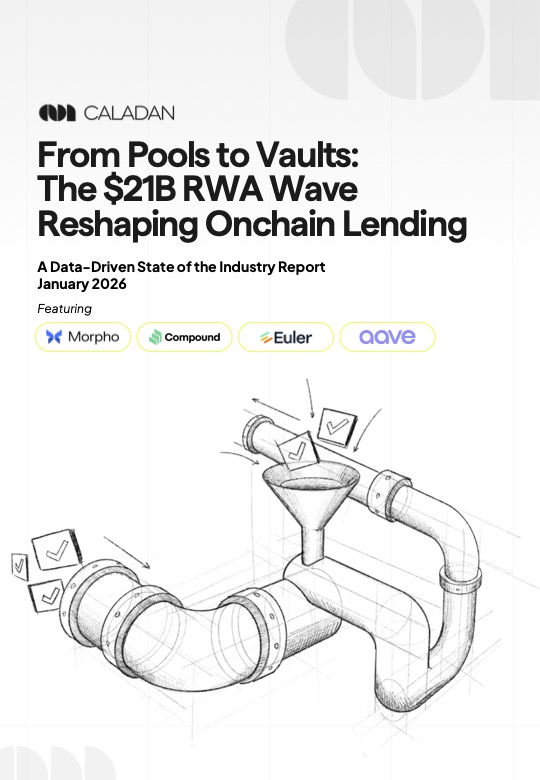
We all know that institutional capital is going to come onchain at scale. In fact, a lot of it already has. Hence, we wanted to map out where said institutional capital will flow into in the next 1-2 years by digging deep into the onchain lending landscape.
A TLDR of what we found: 78% of DeFi lending protocols operate on an architecture that creates systemic risk (and hence institutions cannot touch). The remaining 22% is/will be capturing disproportionate growth.
The full report digs into the five forces determining which protocols win: capital efficiency, risk architecture, RWA integration capability, developer ecosystems, and multi-chain distribution.
It covers how the curator economy works (26 independent risk managers now compete for $4.4 billion in deposits), why Gauntlet left Aave for Morpho, what the Coinbase and Ethereum Foundation deployments reveal about institutional requirements, and how three different scenarios for 2026 to 2028 could play out.
There is also a full breakdown comparing protocol tiers, from Aave’s $34 billion dominance down to emerging players carving out niches on specific chains.
Executive Summary
The onchain lending sector reached $67.4B in January 2026, up from $19.7B in early 2024.
Within this market, a fundamental architectural divide has emerged: pooled protocols, which share risk across liquidity pools, versus isolated market protocols, which compartmentalize risk while aggregating capital through curator-managed vaults.
Market Structure
Aave V3 leads with $34.3B TVL (50.9% share). Morpho ranks #2 with $6.412B TVL (9.5% share), having grown 58,000%+ from $11M in 24 months while originating $1.25B+ in institutional loans through Coinbase alone.
Institutional Adoption
Morpho secured the first G-SIB (globally systemically important bank) partnership when Société Générale selected it for MiCA-compliant stablecoins. The Ethereum Foundation, Coinbase, and Fasanara have also deployed significant capital.
RWA Opportunity
The distributed tokenized RWA market stands at $21B, projected to reach $2T by 2028.
Protocols with institutional-grade compliance capabilities are positioned to capture this growth.
Five Forces
Capital efficiency, risk architecture, RWA integration capability, developer ecosystems, and multi-chain distribution consistently predict protocol success.
Core Thesis
Isolated market architecture meets institutional requirements—risk compartmentalization, compliance flexibility, and audit certainty—that pooled models cannot fully address.
In onchain lending, how you build matters as much as what you build.
Read the full report here.

